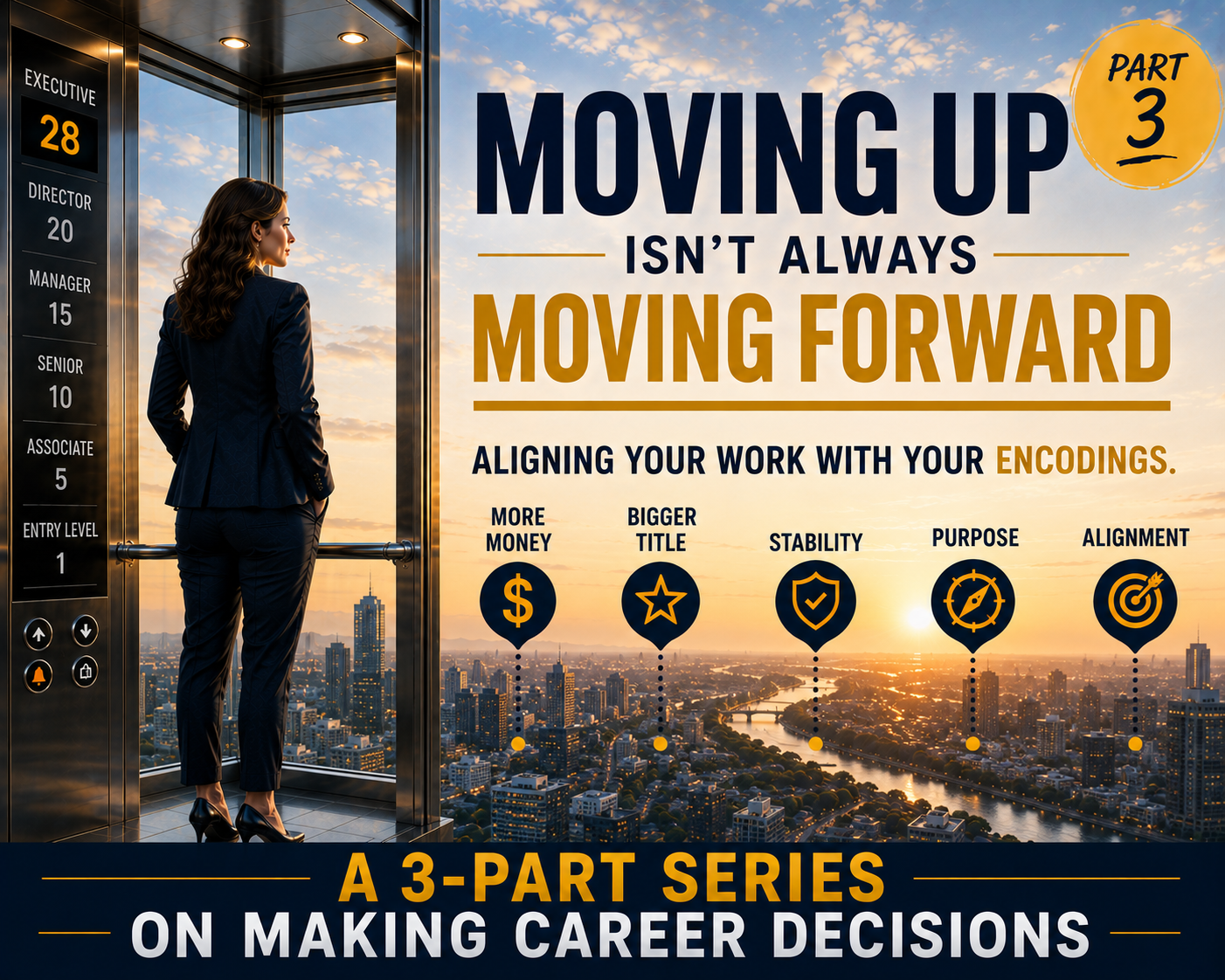
Over the past few weeks, I’ve had the chance to explore career decisions through a few different lenses. In the first post of this series, Molly Kosowski and I unpacked the three main lenses people use when deciding whether to change jobs. Then Bracey Halbrook stepped in to share his brilliant, data-driven framework for calculating the expected value of a career move.
But there’s another lens worth exploring and it’s the one that’s hardest to quantify.
It’s intuition.
Not the “throw caution to the wind” kind of intuition. I’m talking about something deeper. The feeling that says, “This fits me,” even when you can’t fully explain why.
Jim Collins gives language to this idea in his monograph What to Make of a Life. He calls them our “encodings.” Think of them as the innate wiring that shapes who we are, what energizes us, and the type of work we were naturally built to do.
I’ll be honest. This concept resonates with me.
When I made the leap to start my own recruiting firm years ago, I spent time thinking through how to approach the work and did my due diligence for getting started. But I did not have a complex spreadsheet completely filled out with exactly how I was going to accomplish it. What inspired my work more than anything else was a quiet, persistent pull toward building something of my own and working directly with people in a specific way.
Reading What to Make of a Life years later gave me simple, clear language for what I experienced back then.
The Critical Divide: Success vs. Alignment
One of the biggest traps in professional life is assuming that because you’re successful at something, it must be what you’re supposed to do.
Those are not always the same thing.
I’ve seen executives who are natural builders spend decades in maintenance roles. I’ve met people wired to develop others who found themselves buried in spreadsheets all day. I’ve talked with highly relational leaders who took jobs that required them to spend most of their time alone.
They were successful. They just weren’t aligned.
In Collins’ words, the “frame” is a metaphor for your current life context, role, or environment. Being “in frame” means your daily activities align with your innate, intrinsic capacities—what Collins calls your “encodings”—causing things to click and work naturally.
Your frame serves as a filter for what belongs in our lives and careers. When our work fits our frame, we tend to experience both success and fulfillment. When it doesn’t, even impressive achievements can feel strangely empty.
Three Keys to Finding Your Frame & Unlocking Your Natural Encodings
If you want to build a career that actually fits, you have to uncover your unique wiring. Here are three practical ways to start paying attention to your encodings.
1. Pay Attention to Your Energy
Forget titles for a moment. Pay attention to your energy.
What parts of your job make time disappear? What activities leave you feeling energized at the end of the day? Conversely, what responsibilities feel like they require twice as much effort as everyone else?
This doesn’t mean you’ll love every part of your job. That’s not reality.
But if a role requires you to spend 80% of your time doing things that drain your battery, that’s worth paying attention to.
Your energy is trying to tell you something.
2. Look Backward to Move Forward
Jim Collins argues that our encodings reveal themselves early.
Think back to childhood…. Were you the kid organizing neighborhood games? Starting businesses in the driveway? Fixing things? Writing stories? Asking a million questions?
Now think about your early career.
What work came naturally to you? What did people consistently ask for your help with? What did you do before anyone was paying you extra to do it?
For me, I’ve always been fascinated by people and their stories. That’s shown up in almost every chapter of my life. Talent acquisition just happens to be one of the places where that encoding found a home.
Your past often leaves breadcrumbs for your future.
3. Refuse Someone Else’s Playbook
This may be the hardest one.
At some point, all of us have to decide whose definition of success we’re pursuing…. Your parents? Your peers? Your industry?
It’s remarkably easy to spend twenty years climbing a ladder only to realize it was leaning against the wrong wall.
The older I get, the more convinced I am that fulfillment has less to do with prestige and more to do with alignment.
The world will always offer you a playbook. Your job is deciding whether it was written for you.
Find Your Frame: Conduct an Alignment Audit
If you want to run a quick self-check on your current trajectory, take a quiet moment and answer these six questions:
- When am I most alive at work?
- What work feels almost effortless?
- What work consistently leaves me exhausted?
- What compliments have followed me throughout my career?
- What would I do if nobody applauded?
- What kind of problems do I genuinely enjoy solving?
More Resources for Exploring Your Encodings
If you’re struggling to identify your encodings, here are a few resources that have been helpful to me and others:
- Read Jim Collins’ What to Make of a Life. It’s short, thoughtful, and worth revisiting every few years.
- Check out Navigating the Journey to Find Work You Love, a blog post I wrote with my friend Chris Wall that unpacks some universal truths for discovering work worth doing.
- Ask five people who know you well: “What do you think I do naturally better than most people?”
- Keep an “energy journal” for two weeks. Write down the tasks that energize and drain you.
- Consider assessments like CliftonStrengths or the Enneagram to help you identify some of the ways you’re uniquely wired and how you see the world. They’re not definitive, but they can provide helpful language.
A Final Word of Encouragement: Uncovering Your Frame Takes Time
Discovering your encodings is rarely a weekend project. It happens over years and decades. The older I get, the more clearly I see my own core values, strengths, and limits. It takes patience to notice the patterns.
I’ve learned more about myself in the last ten years than I did in the previous twenty. Some of that comes with age. Some of it comes from paying closer attention.
The truth is, understanding yourself is a lifelong project.
Bringing It All Together
As we wrap up this three-part series, I’m reminded that healthy career decisions rarely happen through a single lens. They happen when we use all of them together.
- Self-awareness helps us understand how we naturally make decisions.
- Logic helps us evaluate risk and opportunity.
- Alignment ensures we’re building a life that honors who we were created to be.
Career decisions will always involve uncertainty. There will never be a perfect formula. But when your head, your heart, and your natural wiring all begin pointing in the same direction, you’ll usually know. And that’s often a pretty good sign that you’ve found your frame.
By Kent Wilson