
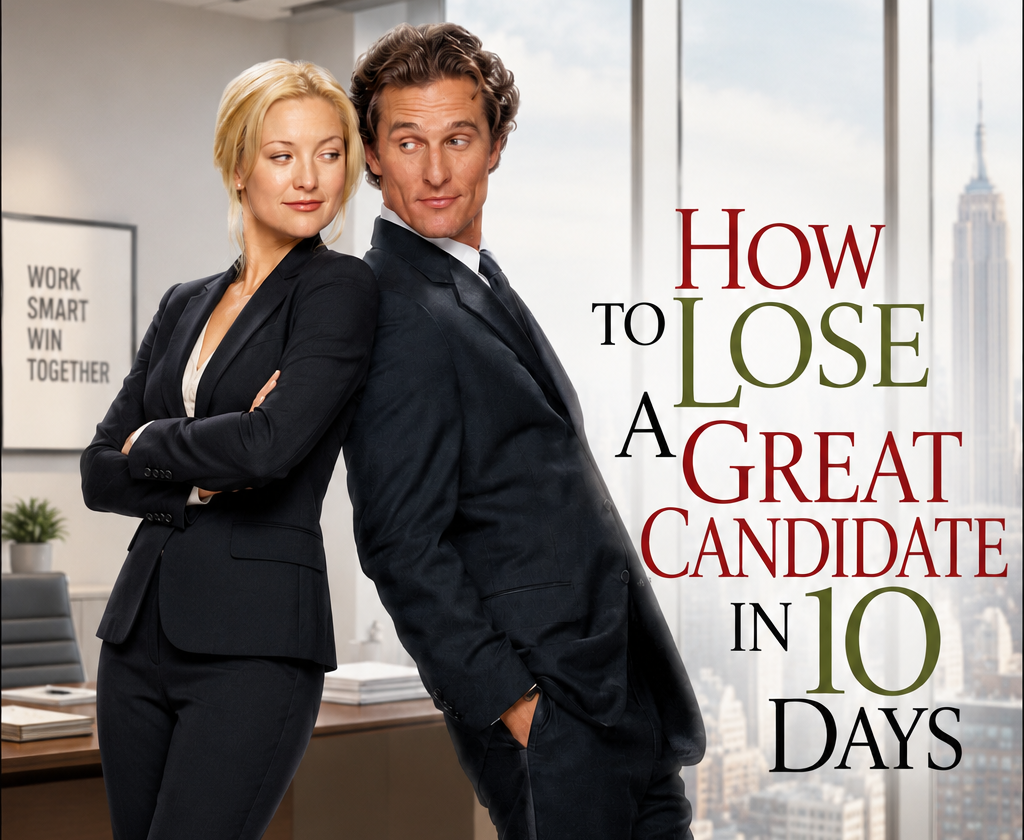
Most of us remember the movie How to Lose a Guy in 10 Days.
Kate Hudson spends the entire movie trying to drive Matthew McConaughey away as quickly as possible. Every decision creates friction, confusion, and frustration until eventually he reaches his breaking point.
While most organizations certainly aren’t trying to lose great candidates, I’ve watched many unintentionally follow a remarkably similar script.
As a recruiting professional, I’ve seen organizations spend months discussing talent acquisition strategies, employer branding initiatives, and workforce planning, only to lose exceptional candidates because the hiring process itself became the obstacle.
Ironically, some of the strongest candidates I’ve represented never accepted another offer because they found a better opportunity. They accepted another offer because someone else made a decision.
The Cost of Slow Decision-Making
One of the biggest misconceptions in hiring is that great candidates will simply wait.
Many organizations assume that if a candidate is interested enough, they’ll remain engaged throughout an extended interview process. Unfortunately, that’s rarely how today’s market works.
The strongest candidates are often evaluating multiple opportunities simultaneously. They are having conversations with several organizations, receiving outreach from recruiters, and carefully assessing not only the role itself but also the leadership team, culture, and decision-making process.
The hiring process becomes a window into how an organization operates. When communication is delayed, feedback takes weeks, or interview rounds continue expanding, candidates begin drawing conclusions. They start asking themselves whether decisions are always made this slowly, whether leadership is aligned, and whether they will encounter the same obstacles once they join the company.
In many cases, the hiring process tells candidates far more about an organization than any recruiter, hiring manager, or executive ever could.
When the Real Problem Isn’t Talent
Over the years, I’ve watched exceptional candidates walk away from opportunities they were genuinely excited about.
One of the most memorable examples wasn’t a professional search—it was an executive search.
The role was important, the candidate market was strong, and we identified qualified leaders almost immediately. From a recruiting standpoint, the search could have been completed in about a month.
Instead, it lasted nearly nine months.
The issue wasn’t talent. It was internal alignment.
Differing opinions among members of the leadership team, competing priorities, board involvement, and ongoing debates about the scope of the role created a series of political landmines that slowed decision-making at every turn. As expectations shifted and additional stakeholders were added, momentum disappeared.
That search reinforced a lesson I’ve seen repeatedly throughout my career: organizations often believe they have a talent problem when they actually have an alignment problem. When leadership isn’t aligned, even the best candidates and the strongest opportunities can get stuck in limbo.
The Candidate Who Simply Walked Away
Not all examples involve executive-level searches.
In another search, a highly sought-after professional candidate completed an initial interview and was eager to move forward. The hiring manager loved the candidate, but additional interview rounds were added along the way. Meetings were rescheduled, calendars became difficult to coordinate, and updates became sporadic.
After several weeks, the candidate called and withdrew.
Not because they disliked the opportunity.
Not because compensation wasn’t competitive.
They withdrew because they lost confidence that the organization could make a decision.
Great Candidates Have Options
Top performers are rarely sitting on the sidelines waiting for an opportunity to appear.
More often, they’re already employed, succeeding in their current roles, and being contacted by recruiters and competitors. They have choices.
Because they have choices, they evaluate every aspect of the hiring experience. They notice how quickly interviews are scheduled. They notice how leaders communicate. They notice whether expectations are clear. And they notice when an organization appears uncertain about what it wants.
Momentum matters.
Every day that passes without communication creates risk. Every unnecessary interview round creates friction. Every delayed decision increases the likelihood that another company will step in and move faster.
Speed Is Not the Same as Rushing
Whenever I talk about hiring speed, someone inevitably assumes I’m advocating for rushed decisions.
I’m not.
The best organizations aren’t successful because they rush. They’re successful because they’re prepared.
Before interviews begin, they have alignment around what success looks like, who the decision-makers are, what compensation parameters exist, and what qualifications truly matter. That preparation allows them to move decisively when the right candidate appears.
The organizations that struggle most with hiring are often not lacking talent. They’re lacking alignment.
When priorities change mid-search, additional stakeholders are added late in the process, or feedback takes weeks to collect, candidates feel the uncertainty immediately. And uncertainty is rarely attractive.
The Market Rewards Decisiveness
Today’s hiring environment has changed dramatically.
Candidates have more visibility into opportunities than ever before. Geographic barriers are lower. Professional networks are larger. Recruiters have greater access to talent. Information travels faster.
As a result, organizations are no longer competing solely on compensation.
They’re competing on candidate experience.
They’re competing on communication.
They’re competing on responsiveness.
And they’re competing on speed.
The organizations that consistently attract top talent understand that recruiting is not an administrative task. It’s a strategic business function that directly impacts growth, innovation, culture, performance, and long-term success.
Final Thoughts
If your organization consistently loses strong candidates late in the hiring process, it may be worth examining something other than the talent market.
Take a hard look at the hiring process itself.
Are decision-makers aligned before the search begins?
How long does it take to schedule interviews?
How quickly is feedback provided?
Are candidates given clear expectations?
Is the process designed around finding great talent—or around internal convenience?
The organizations that win top talent aren’t always the ones with the largest budgets or the most recognizable brands.
More often, they’re the organizations that create clarity, maintain momentum, communicate effectively, and make decisions with confidence.
Because in today’s market, great candidates don’t stay available forever.
And sometimes, it only takes ten days to lose one.
By Kent Wilson