
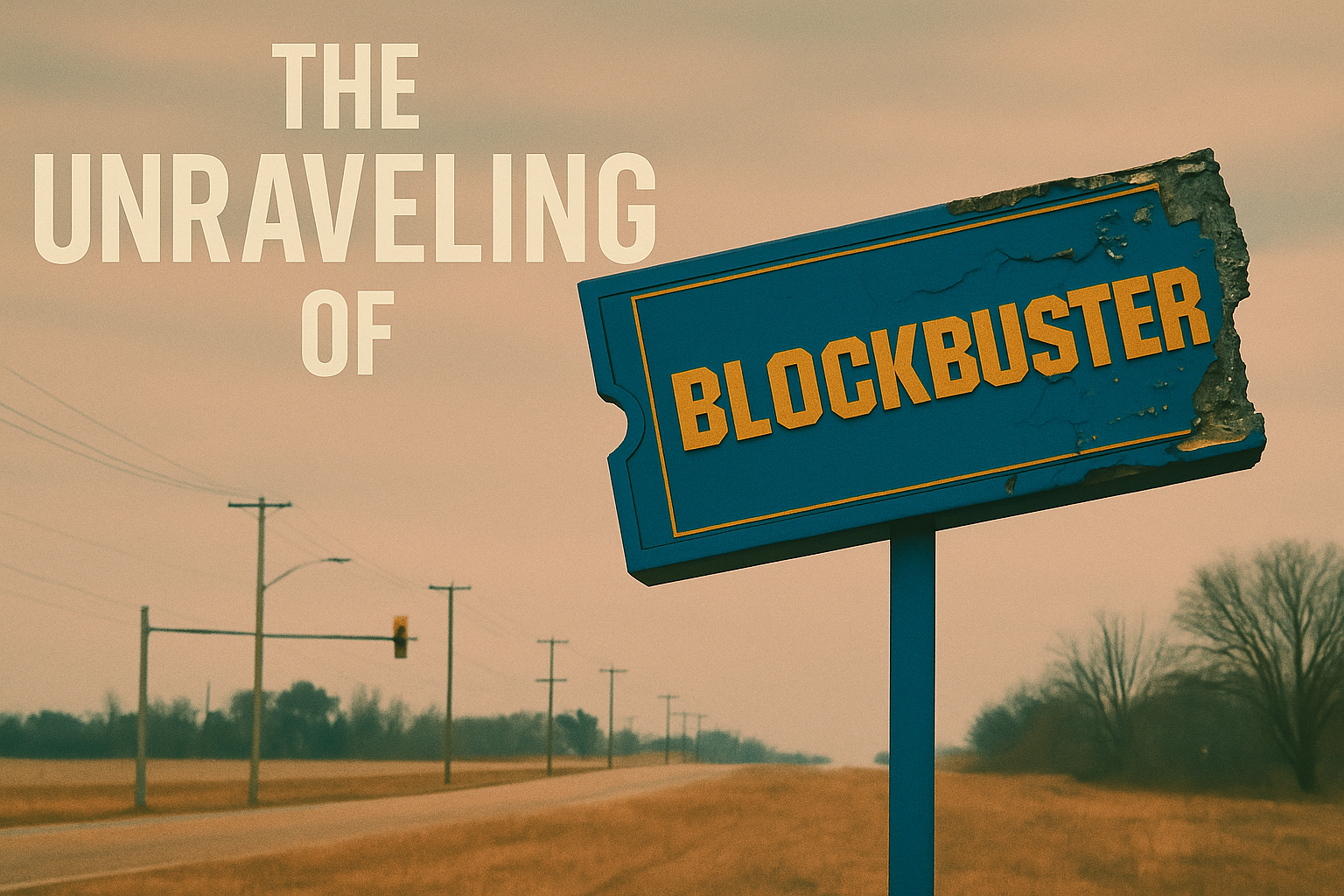
This month marks 15 years since Blockbuster Video declared bankruptcy. I worked at a Blockbuster store in Tulsa, OK while I was in college, and I absolutely loved the video store environment. As a movie buff, it felt like the ideal job — I was literally paid to talk about movies all day. What’s not to like? Add in the perk of two free rentals every day, and I couldn’t have been happier. For me, Blockbuster wasn’t just a job; it was an experience, a community, and a cultural hub.
That’s why the company’s eventual bankruptcy in September 2010 was more than a business story — it was the end of a cultural era. Jim Collins’ How the Mighty Fall provides a framework to understand Blockbuster’s collapse, and the documentary The Last Blockbuster adds real-world voices and quotes that give the decline a human dimension. Together, they show how even the mightiest companies can crumble when they fail to adapt.
Stage 1: Hubris Born of Success
At its peak, Blockbuster operated over 9,000 stores and dominated Friday night entertainment. Success bred confidence—arguably overconfidence. When Netflix proposed a partnership in 2000, Blockbuster’s executives dismissed it.
As Netflix’s co-founder recalled: “Blockbuster laughed us out of the room” when Netflix pitched the idea.
That moment of hubris exemplifies Collins’ first stage of decline: believing past success guarantees future dominance.
Stage 2: Undisciplined Pursuit of More
Rather than innovating, Blockbuster expanded relentlessly—new stores, new ventures, higher fees. The company chased growth for growth’s sake, stretching resources and customer goodwill. This undisciplined pursuit left little room to rethink the model as digital disruption loomed.
Stage 3: Denial of Risk and Peril
As Netflix’s DVD-by-mail and Redbox’s kiosks took off, Blockbuster leaders downplayed the threat. In The Last Blockbuster, Sandi Harding, general manager of the last store in Bend, Oregon, reflects the ethos of holding on:
“We didn’t want to give in.”
This refusal to acknowledge how fundamentally the industry was changing mirrors Collins’ “denial of risk and peril.”
Stage 4: Grasping for Salvation
When revenues fell, Blockbuster scrambled. It launched Blockbuster Online, partnered with Movielink, and even briefly ended late fees. These were desperate, reactive moves.
The documentary highlights nostalgia as the company’s lifeline:
“People can come in and really get a taste for what it was like to walk around in a Blockbuster,” Harding notes about the Bend store.
That nostalgia resonated with customers but could not save the corporation.
Stage 5: Capitulation to Irrelevance or Death
By 2010, Blockbuster’s nearly $900 million debt was unsustainable. Bankruptcy followed, and most stores closed. Today, the Bend store lives on as a nostalgic relic — “The Last Blockbuster” — a living museum for a company that once ruled an industry.
Lessons for Leaders Today
Blockbuster’s story isn’t just about missed opportunities; it’s about how success can blind organizations. Collins’ framework shows us:
- Hubris blinds leaders to threats.
- Undisciplined growth stretches focus thin.
- Denial prevents hard pivots.
- Grasping for salvation leads to reactive, short-term fixes.
- Capitulation is the result when adaptation comes too late.
For me, Blockbuster was a cherished part of my youth — an experience of community, film culture, and connection. But as How the Mighty Fall and The Last Blockbuster remind us, even the most beloved institutions can crumble without humility, discipline, and a willingness to evolve.
By Kent Wilson